
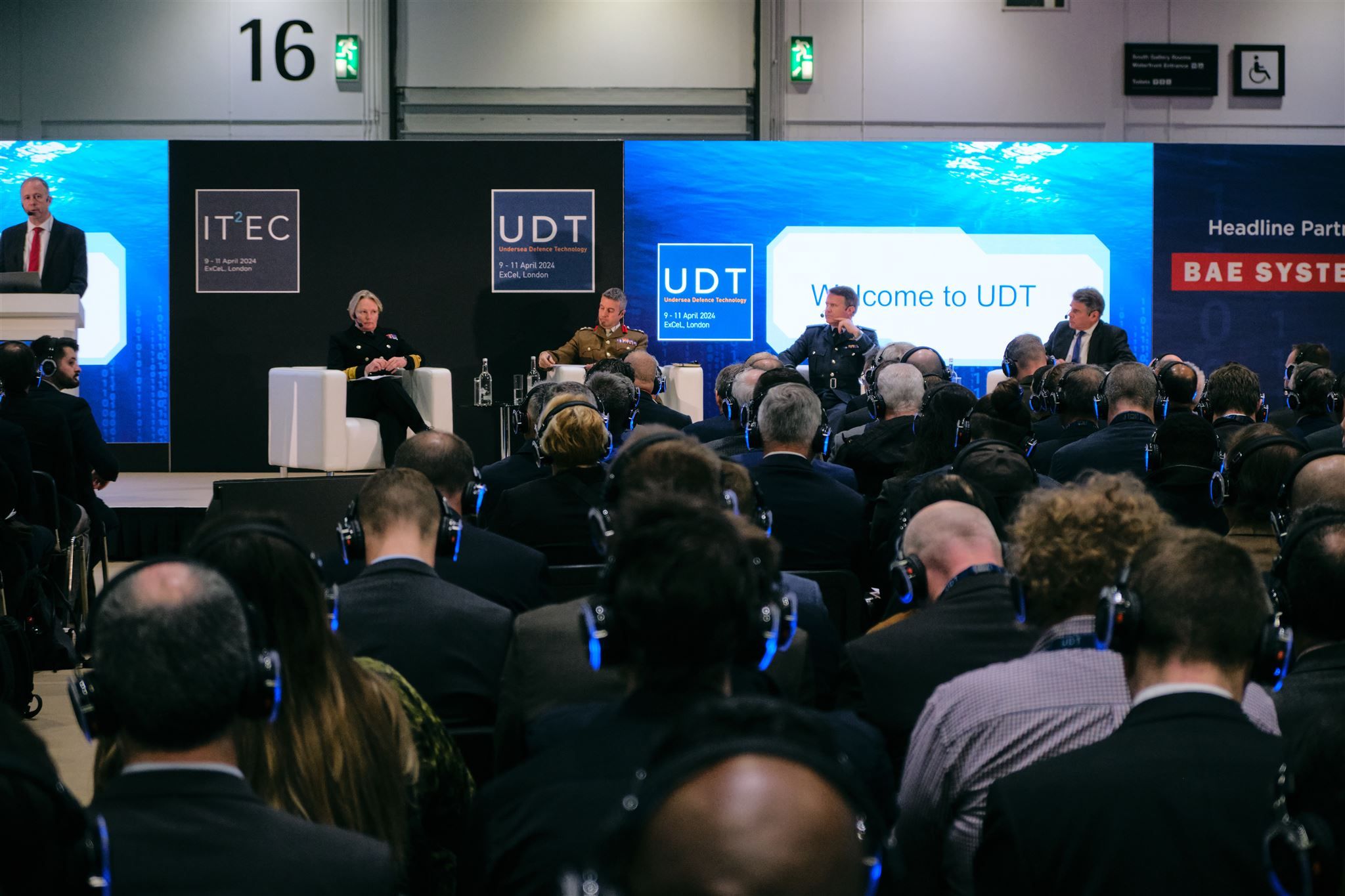
Our technical conference programme remains one of the biggest draws of UDT and continues to expand with new speakers, conference material and more comprehensive content to date.  

With over 1,500 naval professionals, across three theatres and our keynote theatre, UDT 2026 remains the global leading event dedicated to undersea defence technology, bringing together the largest gathering of professionals, industry and military experts to discuss the ongoing issues in the naval industry.  

Our conference speakers offer valuable insight into the technical themes set by our dedicated committee members. Interested in attending our research-rich technical conference sessions and keynotes? 
conference

UDT 2026 Conference Theme - Advantage through undersea technology

 UDT 2026’s theme Advantage through Undersea Technology captures the urgent need to accelerate and manage innovation, seamlessly integrating emerging technologies into effective operational capabilities. UDT 2026 will prioritise conversations and investment through three key areas: 

Autonomy: The critical role of autonomous and unmanned systems in expanding operational reach and enhanced decision-making. 
Application: The defence sector’s need to rapidly adapt to changing threat environments, especially with the emergence of novel technologies and near-peer adversaries.  
Agility: Success hinges not only on innovation but on how quickly and affordably these capabilities can be developed, procured and delivered at scale.

This theme reflects a critical tension raised by the wider undersea defence technology community: while there is increasing  interest in advanced technologies, from artificial intelligence (AI) and autonomous platforms to distributed sensing and electric propulsion, success hinges not only on innovation but on how quickly and affordably these capabilities can be developed, procured and delivered at scale. 

Operational effectiveness

Explores the changing balance of factors that navies must understand to achieve and sustain their advantage in the Undersea Battlespace.  That advantage may be in exploiting the undersea environment or preventing an opponent doing so. Aspects include: 

  • The impact of a changing strategic environment and complex, environmental extremes in the undersea battlespace. 

  • Identification and management of evolving threats and the need for rapid response and assurance of target defeat in congested subsea theatres. 

  • Modern Anti-Submarine and Anti-Surface ISR & Warfare (ASW and ASuW), including survivability, stealth and offensive operations. 

  • Seabed and mine warfare (SBW and MW) including area defence and protection of critical undersea Infrastructure. 

  • Training and Simulation 

  • Evaluation and testing, capability sustainment 

  • Multi-vehicle, system and domain integration 

Multi-disciplinary solutions

Examining how technologies and knowledge from different domains and disciplines can be integrated to deliver smarter, more resilient undersea defence solutions: 

  • Cross-domain innovation (including integration of seabed to space, cyber, air-maritime integration) 

  • Climate and oceanographic science with defence implications 

  • AI data-driven decision support: big data analytics, automated data classification, anomaly detection and sensor data processing  

  • Data science, digital twins, and decision support tools 

  • Advanced materials, energy systems, bio-mimetics and sustainable tech’ 

  • Human performance in undersea operations (diving, psychology, health) 

  • Multi-use technologies that could be adapted for defence needs 

Platforms and Autonomous vehicles

Focused on the development, integration and sustainment of crewed platforms, autonomous, uncrewed, and remotely operated vehicles. 

  • Programme-level development, build and sustainment of submarines and autonomous and uncrewed vehicles and their systems 

  • Improvements in stealthy operation, efficient propulsion, endurance, navigation, human factors and habitability, supportability, modularity and communications arrangements 

  • Integration of autonomous, uncrewed and remotely operated vehicles to into the force structure to maximise advantage in the undersea domain, including extending reach, endurance and functionality 

  • Energetics for long-duration missions, low-power ops, and green propulsion 

  • Collaborative autonomy: multi-platform coordination and control 

  • Navigation and detection in complex undersea environments  

  • Incorporating autonomy into existing fleets, CMSs and C2 infrastructure 

Sensors, Weapons and Countermeasures

Addressing the interdependent challenges needed to deal with emerging threats in dense and dynamic subsea environments.  Including: 

  • Combat management systems including AI enabled decision support: big data analytics, automated data classification, anomaly detection and sensor data processing 

  • Collaborative autonomy and seamless incorporation into existing C2 frameworks 

  • Developments in undersea sensing and in acoustic and electronic warfare 

  • Modularity and adaptability in weapons and payload integration 

  • Next generation torpedoes, smart payloads and delivery platforms  

  • Advanced defensive systems and countermeasures 

Innovation and Investment

Finally, to address the urgent need to co-opt new ideas and technologies and manage bespoke developments to enable production at scale and time to contribute to the challenging undersea defence arena. 

  • Industry-government collaboration and trust-building 

  • Agile research & development and procurement, including practicable management of the demand pull and technology push paradigm for long duration submarine and short duration uncrewed vehicle programmes 

  • Accelerated procurement models, including modular upgrades and COTS adaptation, including lifecycle costs, sustainability 

  • Providing scale and depth of research, production and support arrangements and infrastructures 

  • New solutions and innovations to offset industrial and personnel constraints 

  • Budget optimisation and innovation under funding pressures